|
1. The Maidens – Alex Michaelides
2. How to Stop Time – Matt Haig 3. Light Years from Home – Mike Chen 4. Small Admissions – Amy Poeppel 5. The One Hundred Years of Lenni and Margot – Marianne Cronin 6. The Dreamt Land: Chasing Water and Dust Across California – Mark Arax 7. Two Nights in Lisbon – Chris Pavone 8. I’m Glad My Mom Died – Jennette McCurdy 9. The Latecomer – Jean Hanff Korelitz 10. Blankets – Craig Thompson 11. Tomorrow and Tomorrow and Tomorrow – Gabrielle Zevin 12. Sea of Tranquility – Emily St. John Mandel 13. The Love Songs of W.E.B. DuBois – Honoree Fanonne Jeffers 14. Wrong Place Wrong Time – Gillian McAllister 15. The Invisible Life of Addie LaRue – V.E. Schwab 16. Gone to Dust – Matt Goldman 17. Just the Nicest Couple – Mary Kubica 18. The Paris Apartment – Lucy Foley 19. When the World Didn’t End: A Memoir – Guinevere Turner 20. Mad Honey – Jodi Picoult 21. The Rachel Incident – Caroline O’Donoghue 22. Lessons in Chemistry – Bonnie Garmus 23. I Have Some Questions for You – Rebecca Makkai 24. All the Dangerous Things – Stacy Willingham 25. The Vanishing Half – Brit Bennett 26. Our Missing Hearts – Celeste Ng 27. Yellowface – R.F. Kuang 28. An Island – Karen Jennings 29. Demon Copperhead – Barbara Kingsolver 30. The House in the Cerulean Sea – T.J. Klune 31. How High We Go in the Dark – Sequoia Nagamatsu 32. The Guncle – Steven Rowley 33. Interior Chinatown – Charles Yu 34. Station Eleven – Emily St. John Mandel 35. The Quiet Tenant – Clemence Michallon 36. True Biz – Sara Novic 37. Everyone in My Famly Has Killed Someone – Benjamin Stevenson 38. The Golden State – Lydia Kiesling 39. The Lady from the Black Lagoon: Hollywood Monsters and the Lost Legacy of Milicent Patrick – Mallory O’Meara 40. A Friend of the Family - Lauren Grodstein 41. The Weight of Blood – Tiffany D. Jackson 42. Dear Edward – Ann Napolitano 43. Community Board – Tara Conklin 44. We Were Never Here – Andrea Bartz 45. Tom Lake – Ann Patchett 46. The Searcher – Tana French 47. The Crane Wife: A Memoir in Essays – C.J. Hauser 48. Deacon King Kong – James McBride 49. Carrie Soto is Back – Taylor Jenkins Reid 50. The Couple at Number 9 – Claire Douglas 51. Lawn Boy – Jonathan Evison 52. Poverty, by America – Matthew Desmond 53. Martyr! – Kaveh Akbar 54. The Nix – Nathan Hill 55. Safe and Sound – Laura McHugh 56. American Spirits – Russell Banks 57. Romantic Comedy – Curtis Sittenfeld 58. Hotel Cuba – Aaron Hamburger 59. The Paper Palace – Miranda Cowley Heller 60. Fourth Wing – Rebecca Yarros 61. The Soul of an Octopus – Sy Montgomery 62. The Essex Serpent – Sarah Perry 63. Hamnet – Maggie O’Farrell 64. Everyone is Watching – Heather Gudenkauf 65. In an Instant – Suzanne Redfearn 66. Twenty-Seven Minutes – Ashley Tate 67. Everyone on This Train is a Suspect – Benjamin Stevenson 68. Once Upon an Effing Time – Buffy Cram 69. Let Us Descend – Jesmyn Ward 70. The Postcard – Anne Berest 71. Only if You’re Lucky – Stacy Willingham 72. Listen for the Lie – Amy Tintera
1 Comment
Yesterday, I finished proofreading, formatting, saving and uploading the last of the documents for my teaching portfolio, which I’ve known about forever, worked on haphazardly for most of the summer and then attacked seriously for the last two weeks. And then I hit SUBMIT. It’s a damn shame that this action wasn’t accompanied by a flutter of digital confetti, or even an anonymous, pro forma, auto-generated email. Thank you for submitting…
But still: it is finished. Now the files will sit in digital limbo until they begin working their way through/up the system of peers and administrators and directors and the personnel office and the dean, until someone decides at the end of the next academic year that I’m either good at my job (a nice raise) or not. ** A week ago, I changed into the hospital gown with the snap closures in the front and when prompted by the friendly technician, presented my breasts one by one for flattening between two plastic plates. I held my breath through the beeping. I was too filled with the customary dread to breathe anyway. It was my regularly scheduled mammogram, due to a well-documented familial health history that I review at the start of each exam, conjuring my ancestors one by one in my mind. I never miss a mammogram. It’s on my calendar already to schedule next year’s exam the minute my insurance allows me (7/26/2024). I have no reason other than this history to suspect something is wrong, except in the days leading up to the exam, I always manage to convince myself that something is wrong, that the size or shape or texture of my tissue is different, that there is tenderness or pain for no discernable reason. By the time I’m half-naked, my breast being compressed to the flatness of, if not a pancake, then a rounded baguette, I’m in full doomsday mode. (A word, also, about mammography. Every technician for twenty years of mammograms has said the same thing to me: obviously the machine was designed by a man, and we chuckle wryly as she positions my feet and breasts and chin and shoulders, all parts of me pushed against unforgiving plastic, limbs contorted to get the right image. Can we not, in 2023, do better?) “You’ll get your results in a few days,” the technician says, and when I exit the exam room to return to the dressing room down the hall, another kind of countdown has begun: the waiting. I go through the motions of life: meeting with my writing group, watching Barbie with two badass friends, a Seinfeld-themed birthday party, my duties as liturgist at church, teaching my online class, commuting to my summer internship. Days pass, during which I log into my health app a few dozen times, and then finally, in desperation, send an email to my primary care doctor. The reply comes pretty fast, but not before I’ve mapped out other dismal scenarios, all of them involving major life changes. The lab is backed up, but you should be hearing results soon. This morning, while I was in the yard trying to tame the beast that is our upright rosemary plant, my phone pinged with a notification from my health care app. I sat down on the front stoop and said a prayer and opened the letter and started crying, because there’s no evidence of malignancy, and because I’m so stupid to let my mind go there all the time, and because I’m so grateful, so damn grateful, to have this news. ** Earlier this summer, I went into my home office to find that the metal ceiling vent, along with two long screws and a shocking amount of plaster, were scattered about my desk chair and the surrounding carpet. Directly above the spot where I sit for Zooms of all sorts—but mostly teaching, meetings—was a gaping hole where the vent cover had been. Will was sitting in the living room, the Padres on TV. “Did you hear a loud crash earlier?” I asked. He shrugged. Loud crashes aren’t uncommon in our neighborhood. After close study by two non-handy people, we realized the vent cover was never going back up there—the missing chunks of plaster were the only place to screw a vent cover in place. It’s a case for the professionals, which means it will sit for a few months until I have a few other projects that all need to be tackled right now, and in the meantime, it’s *delightfully* cool under the ceiling hole and this dodged bit of metal and plaster is another reason to be grateful. ** Right now, right this very minute, I’m the sole customer at the Starbucks on Prescott/Briggsmore. Cher is coming through the speakers. I’m caffeinated. My laptop battery is at 77%. I had a good phone call this morning about a new venture (I promise to not always be so vague, but please tolerate my vagueness for just a bit longer), and I’m feeling hopeful. Things are looking up. 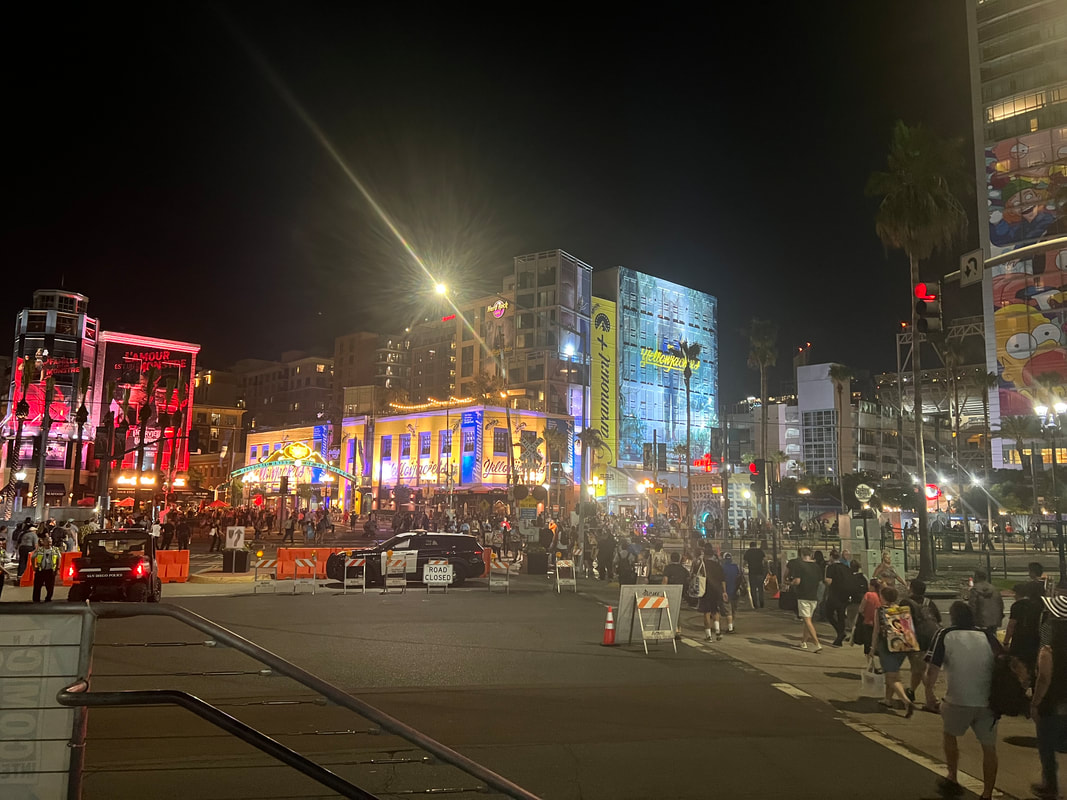 I’m in San Diego, sitting on the patio of the condo we’re borrowing from gracious friends, listening to the city—the stadium is to my left, and further that way is the convention center, and the Gaslamp with its million restaurants and costumed tourists is to my right. Will is paging through his ComicCon packet, plotting what he’ll do with his Thursday badge. There’s big nerd energy in the air, and it’s lovely. It’s also 70 degrees, I’m barefoot, there do not appear to be any bugs, and the slightest breeze occasionally rustles past. Did I mention it’s lovely? This is the first thing I’ve written in a while that wasn’t a business plan (more on that eventually) or a lesson plan (teaching a summer session class; 7 days/3.5 weeks to go!), or something for my teaching portfolio that is due September 1 and which I’m determined to finish very soon. In other words, my creative brain is rusty. I worry sometimes that I’ve lost the knack for it. And then on the way here, I thought about writing a flash fiction piece about a guy who doesn’t want to go on vacation because he hasn’t pooped and doesn’t want to use the airplane bathroom. (Believe it or not, this was not autobiographical.) I didn’t write it, but for a few minutes I allowed myself to inhabit the world of this non-pooper/non-vacationer, and how mad his wife would be, and how everything could go slightly wrong National Lampoon-style as a result, and this made me smile. ** Someone on a balcony far above me is talking, and the acoustics are such that it seems like they’re right behind me. It might even be a television, the voice is that modulated, like someone reporting on the stock market. Will went in and came back outside and said that his arm was itching, and it almost looked like hives, or maybe hive singular, as it was just one raised welt where he was itching. Or maybe something was implanted under his skin by an alien being, something that has been slowly altering his DNA and making him into a half-vegetable/half-man and he’s only just now becoming aware of it. See? Fiction is fun. And it’s probably not even hives. I’ve been sick. It’s not serious—nothing that requires hospitalization or specialists or expensive drugs that my insurance won’t cover. In fact, my doctor diagnosed me with seasonal allergies and, after much pleading on my behalf, also prescribed an antibiotic in case it was something else. By that time, it had been 15 days of general malaise—stuffed nostrils every time I tried to sleep, a shallow, constant cough, a foggy head with slow, dull mental processes, the overwhelming feeling that I wasn’t any better than the day before, and maybe I was even worse. (It should go without saying that I’m throwing myself a pity-party here. But the thing is: I’m not normally sick. I took a sick half-day last year when I had an infected tooth, and before that, my last day off from teaching was in the fall of 2015. Many people have it much worse; I know that. I can only compare this year’s Paula, who has felt not great for roughly half the calendar year, to every other year of Paula, who has rarely suffered a sniffle. The result is not pretty.) Now, 22 days later, either the antibiotic did the trick, or the Claritin performed its magic, or whatever was going on has slowly worked its way through my body—but I’m feeling, today, better. Two nights ago I slept without nasal spray on my bedside table. I didn’t cough so hard I woke up all the humans and pets in my house. Yesterday, I cleared the kitchen counter of the DayQuil, NyQuil, nasal spray, cough drops and the little plastic cups still holding the dregs of orangish medicine. And right now, I’m finally, finally, sitting down again to write. ** It’s been hard, in this sea of self-pity and Gilmore Girls streaming and 9:30 am naps, not to think there’s something deeper at work here. Maybe my life isn’t making me happy. Maybe I’m not spending my time on the right things. Maybe I’m trying to do too much, all at once and my body has put her foot down: No, Paula. Just no. Maybe this time I should listen. ** I know what to do to dig myself out of the too-many-things, because I’ve done it before. Make a list. Prioritize. Set goals and stick to them. Cross one thing off, then another, and don’t look back. But the trick will be: how do I not find myself right back here in a month, with a dozen new commitments and calendar obligations, my personal goals pushed further down the list? ** A friend recently recommended to me You Are a Badass by Jen Sincero. I’m aware of the book cover—I can call up the title font in my mind right now—and aware of the book itself in the vague, fuzzy way I’ve been aware of the entire self-help genre my entire life. Excuse me for thinking that the self-help genre was for other people, that I was already helping myself just fine, thanks. Excuse me for thinking I had nothing new to learn in this area. I decided to listen to the audiobook, and now whenever I get into my car for a fifteen-minute drive across town, the wisdom comes in these short bursts of affirmations, surprising me each time. What am I listening to? And then: Oh, right. I have felt nothing at all like a badass for months, maybe for longer. If there is a badass muscle in my body, it has gone dormant, atrophying in the face of this stupid illness, not to mention the endless and probably futile tasks associated with a job I’ve been doing for what suddenly seems to be a very long time, the constant acquiescence to things I really don’t want to do. I haven’t yet looked at myself in the mirror and proclaimed my badassery. But it’s going to happen. It has to. It will. I sat down in Jenessa’s chair yesterday and for two hours talked about life, my dad, my upcoming plans while she foiled and washed and cut and styled my hair (so long overdue, she really had her work cut out for her), and afterwards felt like I’d just been to therapy. It’s good to talk about things. It’s good to have the words out there in the world, and so I’ll say them here, too.
My dad is dying. Not in the sense that we are all dying, sooner or later, by ways we thankfully can’t imagine, but in the all-too-real, hospital bed and oxygen machines way. He’s reached Stage 4 of his COPD, and while it’s hard to know how much time is left, it’s clear the time is shrinking. There’s much to be done, and that’s kicked me into high gear. I’ve always been able to perform on demand. I’m able to compartmentalize quite well: meet with a hospice care team one day and give a final exam the next, for example, as if two entirely different women are performing these very different tasks. I’m less good at sitting, listening, reflecting. When I’m still, the ache in my heart is too heavy. I can feel it pulling me down, the weight of things said and unsaid, done and undone. And so, I keep moving. ** It’s a Wednesday morning and I’m at home, thighs still throbbing from the YouTube workout I just finished, freshly showered, two dogs napping next to me while I write. I’m not madly printing something out and figuring out what I’m going to wear and packing a lunch and letting the dogs out one last time and making sure there’s at least two hours left on my audiobook. I’m on summer break, even if it is the strangest summer break of my life, where each day has tentative plans that may or may not happen, and it’s impossible to see far enough ahead to do practical things like book plane tickets, build itineraries. Still, I’m ticking things off, slowly, one sub-task at a time: -clean out spare bedroom for Sarah -finish transition documents for Paul -figure out food and transportation for Yosemite retreat ** In Central California, it was a weird spring—far wetter than normal, and colder, too. We were all glued to our weather apps for flood alerts, and when we met in line at the grocery store, all we could talk about was the rain. So much rain. Last year I don’t remember ever wearing a winter coat and this year I took it out to wear and put it away four times thinking that was it, winter had to be over, before taking it out once again. I even wore socks to bed every single night—me, the living furnace. This morning, I woke up shivering, and for a long moment before it all came back to me, I struggled to remember what day it was, what month. But a new season is coming. It’ll be here before we know it. It'll be here, whether we're ready or not. * There’s a mood in here today:
A woman walks into Starbucks wearing a shirt that says FREE HUGS in large letters, and lower, in smaller print: Don’t touch me. She leans back against the wall while she waits for her order, like she’s daring someone to approach her. Two other women sit in the near dark and don’t remove their oversize sunglasses as they eat their heated muffins and stare at their phone screens. The table near the bathroom is free, which is great, because it has a power outlet, and not great, because bathroom traffic passes that way, but it’s where I sit. There’s work to be done, and the clock is ticking. I have two hours to write before my next Zoom meeting. ** Without specifics, it feels like the world is crumbling. In the news, people do horrible things to other people, in the name of their beliefs. Closer to home, people I love are sick and waiting for answers or relief. I’m in limbo, waiting on responses to a half-dozen things. The in-between is a tentative space, like a bridge that might crumble when I’m only halfway across. It feels like the right time to drink hot chocolate and eat buttery cookies and read some Mary Oliver poems. If there was a button that could stop the world, just for a few days or a few million years, I’d push that thing right now. Can’t we all have just a bit more time? ** In my little corner, I’m down to three more teaching days, one-workshop-discussion-day, one more final to write, one literary magazine launch event, a towering virtual stack of things to grade, and my own life to live around all of that. The list greets me every time I log onto my computer, and no matter how much I pick away at it, it never fully goes away. “Some of my professors are so far behind on grading,” one of my students lamented yesterday. “In one class I haven’t had an update since week three.” While this is horrible—I’d be pissed if I were on the receiving end of that non-grade—that did make me feel a bit better. I’m only one week behind, not twelve, after all, and so I have adjusted my level of panic accordingly. I will get done with all of this, somehow. Maybe it will be with wild, high-fiving success. Maybe there will be failures, hopefully minor, and hopefully the people I have failed will be forgiving. Maybe they will extend me grace as I am learning, always, still, to do myself. I wish the same for you. It’s just me, six baristas behind the counter and on the other side of the building, a Couple Having a Serious Discussion. Neither of them looks at me as I enter. Neither of them looks at each other. It’s been a week since I sat here with my manuscript, really liking the way that last scene played out. I figured I’d be back in two days, but then some life happened, and all the things I was behind on demanded my attention at once, and then on the weekend there were two conferences at the university, a workshop I was leading, dinner with the poet laureate, a birthday party, a luncheon, and a long overdue dinner with friends, plus all the stress that comes with my commute (2.5 hours due to traffic yesterday) and my Monday classes, and so, I’m almost crying with relief to be back here. It's been too long, and I have business to attend to. ** I try not to let my gaze rest too long on the Couple Having a Serious Discussion, but I notice they have stopped talking. Both sit with their chins cupped in their palms. What’s so weird about this tableau is that they aren’t looking at their phones. I can’t remember the last time I’ve seen people together just being together, with no media in sight. If I could paint, I would paint them. It’s an Edward Hopper, 2023 style. ** This morning I started the dishwasher before the dog walk, since LG cannot handle the subtle cycle switches and needs to be out of the house during the hour-long cycle. When the three of us returned, one side of the sink held about six inches of brownish water. I took a picture, texted Will, and then went about trying to drain the puddle, which was only accomplished by scooping water with a very small scoop to the other side of the sink. It was then I remembered we have a disposal (a relatively new addition to our lives) and that the last time I tried to use it, which was pre-fall holidays, nothing at all had happened. No whirring sound, no rumble from deep within. I’ll deal with that later, I thought at the time. Today is apparently later. The disposal chicken has come home to roost. ** The Couple Having a Serious Discussion is probably breaking up. They look younger than me, although it’s hard to tell. His head is either shaved or he’s bald, and she has the kind of well-kept beauty that makes age difficult to pin down. Maybe one of them has cheated, or both. Maybe it’s a financial thing, a lost job, lost house. Maybe they’re discussing how to split the assets—furniture, kids, dog. Maybe it’s another scenario entirely. It is, of course, none of my business. ** Today’s high will be 62 degrees, and on Saturday, when I have big plans to clean off my patio for the summer, it will be twenty degrees warmer. This has been one long-ass winter, with a smidgen of spring, too much wind, a whole lotta rain that, this being California, we have no idea how to handle, and day after day of grayish skies. Eighty degrees sounds nice. It feels like find-last-year’s-shorts weather, work-up-a-good-sweat-walking-around-the-block weather, get-out-the-box-fan weather. In no time it will be ninety, one hundred, and we’ll keep our A/Cs running all night and still feel sticky underneath the air vent. ** I get distracted by an email, and when I look up again, the Couple Having a Serious Discussion are holding hands across the table. He’s talking and she’s nodding, and then she talks and he nods. Maybe it’s not a break-up after all. Maybe it’s one of those “we’ve hit this moment and we need to make a decision” talks. Maybe they’ll agree to disagree. Maybe they’ll agree. I wish them the best. It’s 10:15 and I’m in my usual writing spot, only a bit later due to a routine dental appointment. Now I’m sipping my skinny vanilla latte, the old standby, and hyperaware of the fluoride coating on my teeth. I have seven more days of class/three-and-a-half weeks/one lit mag launch/one creative nonfiction workshop/one 47th birthday party/one grant-funded discussion/one writing retreat to plan until the end of the semester, and Lord knows I am ready for it all to be done. ** The older I get, the less I understand how time passes. It is April 11. Yesterday it hit 80 degrees for the first time, and my students, arriving sweaty to class, pronounced it the official beginning of summer. I have planted some seedlings in the raised bed, and other than two squash which look very sketchy, nothing has died. I’m still in the leggings-under-dresses phase of my annual wardrobe, and it seems both too late to be wearing warm clothes and way too early to be thinking about the punishing heat that will soon be here. ** I wrote in an essay-in-progress about something that happened to me recently, followed by my question How the hell did I get here? “What did you mean by that question?” my writing partner asked, tapping her pen against the line. I suppose she was looking for the short-term answer--I got in my car and drove, which was more or less how I’d intended the line when I’d written it, but the answer didn’t seem right to me now, at the moment we were considering it. It seemed more of an existential question, something meant to probe years of decisions and coincidences and accidents, family history, the branches leading backward to the beginning of time. This is the story of how the hell I got here. ** At the Starbucks where I park myself for four hours every Tuesday and Thursday, as well as some Fridays-Sundays when life permits, they have a keypad lock on the bathroom door. At times, the baristas sing out the five-digit code to anyone who asks, and at other times, like now, that information is strictly need-to-know. Something must have happened, like vandalism or a patron who wouldn’t leave, and so now when they are asked, the baristas make an effort to conceal their annoyance, come around the corner, and punch in the code for each guest. “I’m sorry to bother you,” I say when I arrive, fresh from an hour in the dentist’s chair, the orange juice I consumed before that heavy in my bladder, “but could you let me into the bathroom?” The barista, her impressive head of hair piled in a high bun on the very top of her head, glances left and right and leans forward. “I’ll just tell you,” she says, and whispers the five digits that I immediately commit to memory. I have passed a test. I have been deemed worthy. ** Yesterday, after my last class, three students stayed to talk to me—one making a plea for leniency, another providing an explanation for the wrong file that had been uploaded, the third just needing someone to listen. I was lenient with the first, assured the second that we all make mistakes, listened to the third. I left exhausted and made my way straight to the parking lot. It was still warm—the unofficial start of summer, after all—and students were out and about, sitting on benches, skateboarding past. Two students were taking pictures on the sidewalk next to the building with the owls’ nests, and I stopped to ask if they had seen the owls. It had been weeks now since I last spotted them, before the time change, back when I was leaving campus in the dusk. In response, one of the students pointed—not up to the third floor where the branches from their nests still hung over the louvred shades—but straight ahead, just behind the hedge, to where an owl was watching us. It wasn’t one of the parent owls, with their impressive wingspans and weathered faces, and it wasn’t the baby owlet that had blinked down at me weeks earlier. Except, of course, it was—bigger now, maybe an adolescent, with the cool gaze of a teenager. And once again, I don’t understand how time passes. 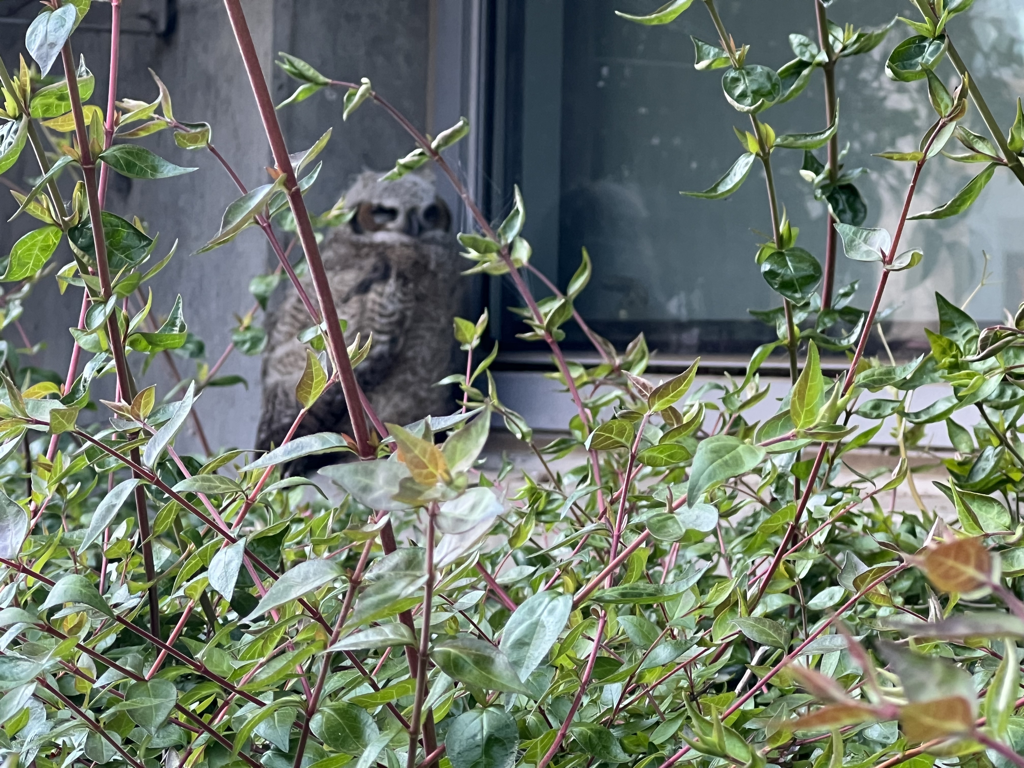 Yesterday, a student emailed me to ask if we had class—basically, if spring break was really over. And while I barked a laugh of amazement at her question, I was kind in my response. We do, I wrote back with a smile emoji. We’re in the home stretch now! But on a deeper level, I get it. I entered spring break with a to-do list a mile long and finished about half of those things, some which I’ll push to summer (closet sorting in the spare room) and some which I’ll scramble to finish this week (notes for a presentation I’ll give next week). For a combination of reasons—tooth infection, lingering cough, exploding sunroof—I’ve felt wrong-footed all semester, only a step ahead when I should have this in the bag. But here we are, back at it. ** Yesterday, I left a mandatory department meeting twenty minutes after the hour and rushed to my class across campus, arriving five minutes late, while my students were clustered near the door debating whether to leave. “It’s only been five minutes!” I said, breathless. Wind had been gusting at 45 mph, and my hair was a tangled knot I itched to work my fingers through. “But you’ve never even been one minute late before,” M. pointed out. He is over six feet, a gentle giant, and his gaze is sympathetic as it travels over my windswept appearance. “It felt momentous.” ** Today I’m at Starbucks for a few hours ostensibly to write, but also I’m behind on my grading, and if I don’t finish at least five papers, I’ll be well and truly screwed by tonight, when I need to read/skim sixty poems and short stories for the lit mag class for which I’m the faculty advisor. These are the kinds of motivational bargains I make with myself: grade one paper, answer an email, grade another paper, five minutes of online browsing for a new area rug. Grade five, and I get to work on my novel. The other day, meeting our nephew’s new girlfriend for the first time at a hotel bar, my husband said, “Paula has a more interesting job than I do” and I nearly choked on my martini. ** Grade, hate myself for assigning so many words in the first place, repeat. ** But even though I’m trying to focus, I can’t turn off the fiction writing part of myself so easily. For example: Two people just entered in full winter coats, hats and boots, abominable-snowman style, asked the barista for the bathroom code, and as I watched writer-eyed, entered the same single-stall bathroom. Was this the perfect setting for a romantic tryst? Were they naked beneath those heavy coats? Would they buy coffee afterwards? Ten minutes later they emerged, hoods clinched tight around their faces, and exited the store. Sometimes the stories just write themselves. Yesterday I planted for the first time in the raised bed planter that was last April’s birthday gift. I meant to plant then, but we were heading out of town for three weeks, and then it was summer, which is unspeakably hot around here and lingers until the middle of October, and then it was winter, and this winter has been wet and windy with surprising cold snaps, and so today in full but feeble sunshine, I finally did the planting.
It was only when the seedlings someone else had started were in the trunk of my car that I realized I have never planted anything before—not really. I transplanted a jade from my father-in-law, and I’ve assisted Will in replacing things that died in our 115+ heat wave last September, and I wrote the check years ago when a nursery came in and planted the trees in our backyard after considerable manipulation of our basically-clay soil. I’m the planner, but not the planter in the family. And so, as I gently removed plant after plant, making a well in the topsoil, and tamping soil firmly back into place while the neighbor’s German Shepherd whined on the other side of the fence, it occurred to me that this entire effort might be a colossal failure. It was suddenly clear that I bought far too many plants for the space, and a whole pack of Swiss chard and three jalapenos won’t be going in. The strawberries are too close together due to a basic math error, I ended up with a squash that is probably perfectly lovely but is not the squash that I thought I was buying, and already I am fighting the urge to overwater everything. On the YouTube videos I watched, too impatient to do anything other than skip ahead to the good parts, people have vibrant gardens, lush and leafy and natural and (seemingly) effortless. These growers seem calm and happy, and probably garden only after half an hour each of yoga and meditation each day. I know I will tend my plants haphazardly, distractedly, my body a ball of stress, the mere existence of my endless to-do list producing great anxiety. But. I have started a thing. It’s a very small act of bravery, a very small act of creation, a very small sign that after this long winter there is hope, and maybe even a vegetable or two, on the horizon. * |
Paula Treick DeBoardJust me. Archives
December 2023
Categories |
 RSS Feed